

Blog
Custom Software vs Ready-Made Software: Which Is Right for Your Business?

Custom Software vs Ready-Made Software: Which Is Right for Your Business?
Choosing the right software can have a direct impact on how efficiently a business operates, manages customers, handles data, and scales. While ready-made software offers a quick and convenient way to digitize business operations, custom software development provides greater flexibility, control, and long-term scalability.
The real question is not simply whether custom software is better than ready-made software. The right choice depends on your business processes, budget, growth plans, integrations, security requirements, and the level of customization your organization needs.
For businesses looking for a custom software development company, understanding the difference between these two approaches is essential before making a technology investment.
What Is Ready-Made Software?
Ready-made software, also known as off-the-shelf software, is a pre-developed application designed to serve a broad range of businesses and users. Popular accounting platforms, CRM systems, project management tools, communication platforms, and HR applications are common examples.
The biggest advantage of ready-made software is speed. A business can purchase a subscription, configure basic settings, add users, and start using the platform without waiting months for development.
For startups and small businesses with standard requirements, ready-made business software solutions can be an affordable and practical option.
However, these platforms are built for the average customer rather than one specific organization. As your business grows, you may discover that certain workflows, reports, integrations, or automation requirements cannot be handled exactly the way you want.
Custom Software vs Ready-Made Software: Which Is Right for Your Business?
What Is Custom Software Development?
Custom software is designed and developed specifically for a particular business, industry, workflow, or operational requirement.
Instead of changing your business processes to fit an existing application, a custom software development company builds the technology around your processes.
For example, a logistics company may require a system that combines order management, fleet tracking, driver management, automated notifications, invoicing, customer portals, and real-time reporting in one platform.
Rather than using multiple disconnected applications, the company can invest in custom business software development that connects these functions through one centralized system.
This approach is particularly valuable for organizations with complex workflows, unique business models, large teams, or specialized operational requirements.
Custom Software vs Ready-Made Software: The Key Difference
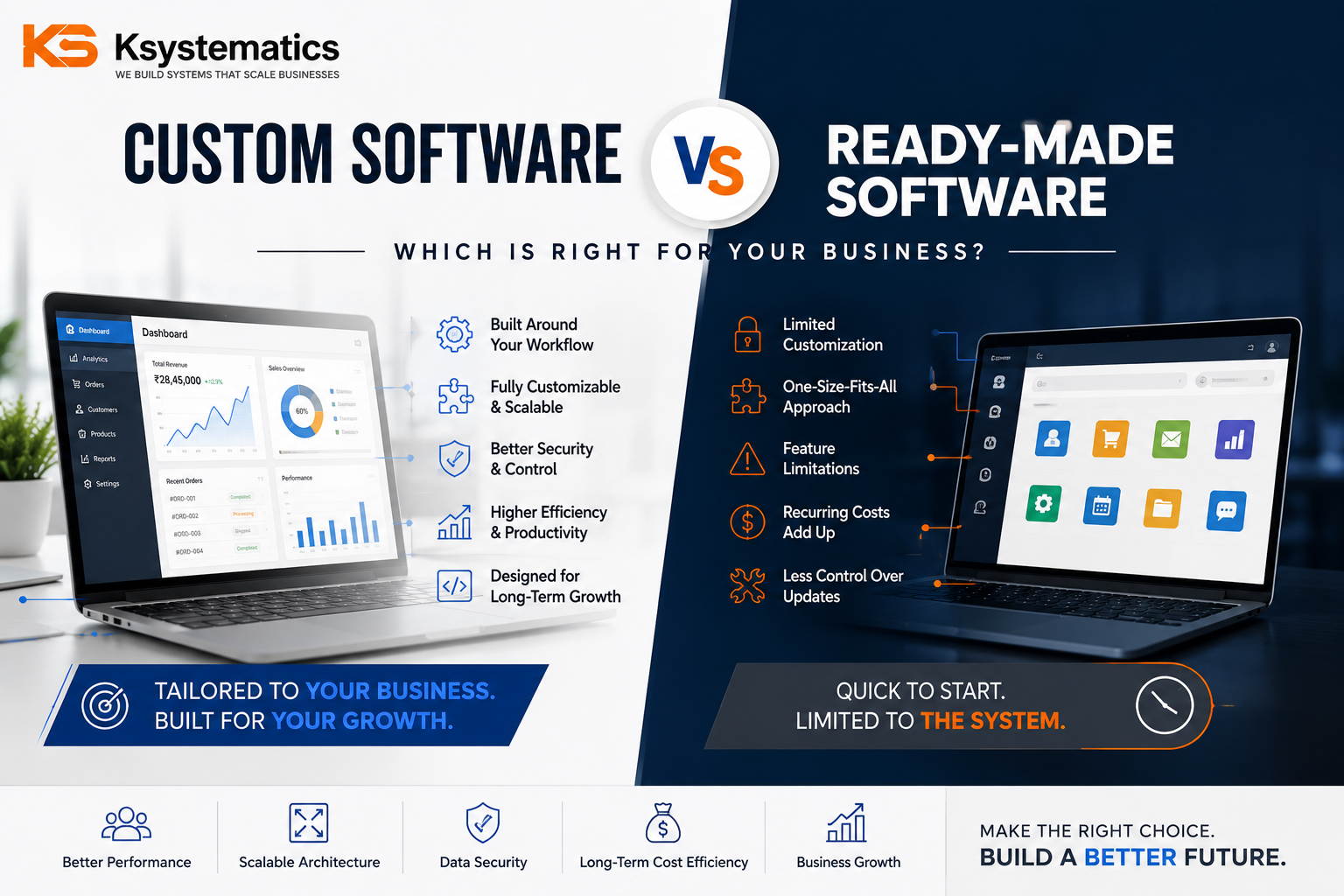
The fundamental difference is flexibility.
Ready-made software asks:
“How can your business work with our system?”
Custom software asks:
“How can we build the system around the way your business works?”
A ready-made application may provide dozens of useful features, but you typically have limited control over its core functionality. With custom software, functionality can be designed around your exact requirements.
This makes custom software solutions for businesses particularly useful when standard software creates operational limitations or forces employees to use unnecessary workarounds.
Cost Comparison: Custom Software vs Ready-Made Software
Cost is often the first consideration when businesses compare custom and ready-made solutions.
Ready-made software generally has a lower initial cost. Most providers operate on monthly or annual subscription models, allowing businesses to start with a relatively small investment.
Custom software usually requires a higher initial investment because it involves business analysis, UI/UX planning, development, testing, deployment, security, and ongoing maintenance.
However, looking only at the initial price can be misleading.
A business using several different subscriptions may eventually spend significant amounts on CRM software, accounting tools, project management platforms, communication tools, reporting systems, and third-party integrations.
If these platforms do not communicate effectively, employees may also spend considerable time manually transferring information.
This is where custom software development for business automation can deliver long-term value by bringing multiple processes into one integrated ecosystem.
Flexibility and Customization
This is one of the strongest advantages of custom software.
Ready-made applications typically offer predefined features and configuration options. Some platforms provide plugins, APIs, or add-ons, but there are still limitations.
Custom software can be developed around your exact workflows.
For example, if your organization requires:
- Custom approval workflows
- Industry-specific dashboards
- Automated notifications
- Role-based access
- Custom reports
- Third-party API integrations
- Automated lead distribution
- Customer portals
- Internal workflow automation
- Advanced analytics
these capabilities can be incorporated into a custom software solution tailored to your business.
This level of flexibility becomes increasingly important as organizations grow and their processes become more sophisticated.
Scalability for Growing Businesses
Software that works perfectly for a company with 10 employees may not be suitable when the organization grows to 100 or 500 employees.
Ready-made software can certainly scale, but businesses may eventually encounter limitations related to users, workflows, integrations, reporting, or customization.
A well-designed custom application can be architected with future growth in mind.
This means scalable custom software development can allow businesses to add new modules, users, workflows, integrations, and capabilities as their requirements evolve.
Instead of replacing the entire system every few years, companies can continuously enhance the platform.
Integration With Existing Business Systems
Modern businesses rarely operate with a single software application.
They may use CRM platforms, accounting systems, ERP solutions, payment gateways, communication tools, marketing platforms, inventory systems, HR software, and analytics tools.
The ability to connect these systems is therefore critical.
Ready-made software may offer integrations with popular platforms, but unusual or highly specific integrations can become challenging.
A custom software development company in India can build APIs and integration layers that allow different business systems to exchange data according to specific operational requirements.
For businesses that depend heavily on automation, integration can significantly reduce repetitive manual tasks.
Security and Data Control
Data security is another important consideration.
With ready-made software, businesses depend largely on the provider’s infrastructure, security policies, update cycles, and data management practices.
This can be perfectly acceptable for many organizations, particularly when the provider has strong security standards.
Custom software gives businesses greater control over how data is stored, accessed, processed, and managed.
Organizations with sensitive customer information, proprietary processes, financial data, or industry-specific compliance requirements may benefit from secure custom software development services designed around their security requirements.
However, custom software does not automatically mean better security. Security depends on development practices, architecture, access controls, testing, infrastructure, monitoring, and ongoing maintenance.
User Experience and Employee Productivity
A major benefit of custom software is that the user experience can be designed around the actual users.
Ready-made platforms often contain features that a business never uses, which can make interfaces complicated for employees.
Custom software can focus only on the workflows that matter.
For example, instead of employees navigating through multiple applications to qualify a lead, assign it to a salesperson, update the CRM, send an email, and generate a report, a custom platform can automate these actions through one workflow.
This is why businesses searching for custom software development for workflow automation often consider customized applications when operational efficiency becomes a priority.
Implementation Time
Ready-made software wins when it comes to implementation speed.
A business can often start using an existing platform within days or weeks.
Custom software requires considerably more planning and development. The process can involve:
- Requirement analysis
- Business process mapping
- Software architecture
- UI/UX design
- Development
- API integrations
- Testing
- Security validation
- Deployment
- Training and support
Therefore, businesses that need an immediate solution with standard functionality may prefer ready-made software.
Organizations looking for a long-term platform built around their unique requirements may be willing to invest additional time in end-to-end custom software development.
Maintenance and Updates
Ready-made software providers generally handle product updates, bug fixes, infrastructure, and new features.
This reduces the technical burden on the customer.
With custom software, maintenance becomes the responsibility of the development team or internal technology team.
Regular maintenance is important to keep the application secure, compatible, scalable, and reliable.
Businesses investing in custom software development services should therefore consider long-term maintenance and support as part of the overall technology strategy rather than treating development as a one-time expense.
When Should You Choose Ready-Made Software?
Ready-made software can be the right choice when:
- Your business processes are relatively standard.
- You need a solution quickly.
- Your budget is limited.
- You do not require extensive customization.
- The software already integrates with your existing tools.
- You are comfortable with subscription-based pricing.
- Your business does not have highly specialized workflows.
For many startups and small businesses, affordable ready-made business software can provide everything required to manage daily operations without the cost and complexity of custom development.
When Should You Choose Custom Software?
Custom software becomes more attractive when:
- Your business has unique processes.
- Existing software requires too many workarounds.
- Multiple systems need to be integrated.
- You want to automate complex workflows.
- Data needs to move automatically between departments.
- You require specialized dashboards or reporting.
- Security and data control are major priorities.
- You expect significant business growth.
- Existing software is becoming a bottleneck.
- Your organization wants technology that provides a competitive advantage.
If your team repeatedly says, “Our software doesn’t work the way our business works,” it may be time to explore a customized solution.
Is Custom Software Worth the Investment?
The answer depends on the business case.
Custom software should not be developed simply because customization sounds attractive. There should be a clear operational or commercial reason behind the investment.
For example, if automation can save hundreds of employee hours every month, reduce errors, improve lead conversion, accelerate customer service, or eliminate several disconnected software subscriptions, the long-term ROI may justify the initial development cost.
A professional custom software development company should therefore begin with business requirements and ROI analysis rather than immediately recommending development.
How to Choose the Right Software for Your Business
Before choosing between custom and ready-made software, ask these questions:
1. How unique are our business processes?
If your processes are standard, ready-made software may be sufficient. If your workflows are highly specialized, custom development may provide greater value.
2. How many systems do we currently use?
If employees constantly move information between different platforms, an integrated custom solution may improve efficiency.
3. What are our growth plans?
Consider whether your current software can support your expected users, transactions, locations, customers, and operational complexity.
4. What is the total cost of ownership?
Do not compare only the development cost with a monthly subscription. Consider integrations, employee productivity, customization, support, migration, and future scalability.
5. What level of control do we need?
Businesses handling sensitive data or specialized workflows may require greater control over their technology environment.
Final Verdict: Custom or Ready-Made?
There is no universal answer.
Ready-made software is ideal when speed, affordability, and standard functionality are the priority.
Custom software is ideal when flexibility, automation, integration, scalability, and business-specific functionality are the priority.
For a small business with straightforward requirements, buying an existing solution may be the smartest decision.
For a growing organization whose processes are becoming increasingly complex, custom software development can become a strategic investment rather than simply another technology expense.
The right technology should ultimately make your business simpler, faster, and more scalable.
At Ksystematics, we help businesses evaluate their technology requirements and build solutions around their actual workflows—from custom software development and business process automation to CRM, ERP, web applications, and integrated digital solutions.
If your existing software is limiting your growth, it may be time to stop adapting your business to software and start building software around your business.
Ksystematics — We Build Systems That Scale Businesses.
#CustomSoftwareDevelopment #CustomSoftwareDevelopmentCompany #ReadyMadeSoftware #BusinessAutomation #SoftwareDevelopment #BusinessSoftware #DigitalTransformation #CRMDevelopment #ERPDevelopment #WorkflowAutomation #CustomBusinessSoftware #SoftwareCompanyInGurgaon