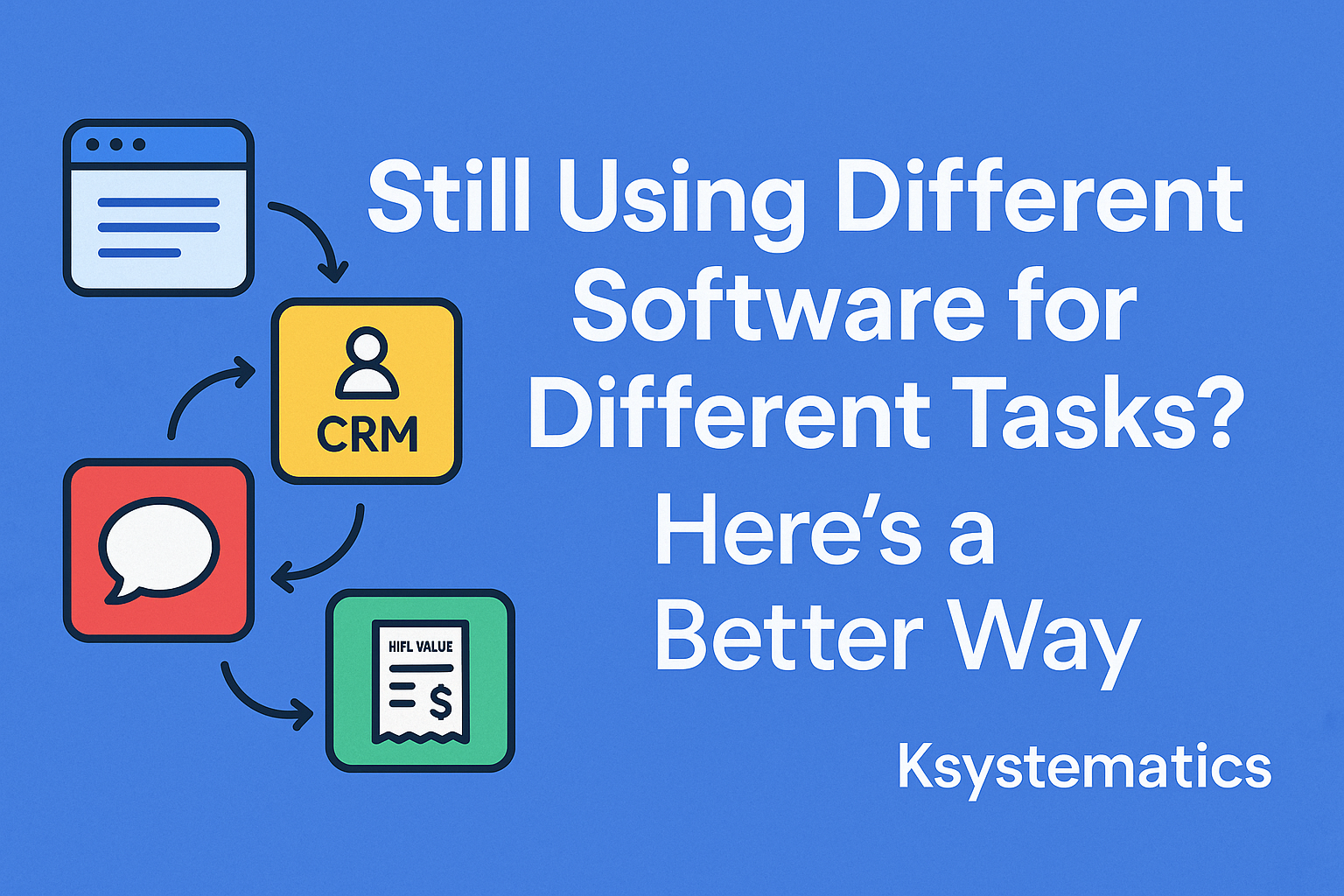
Still Using Different Software for Different Tasks? Here’s a Better Way
The Everyday Problem of Using Multiple Software Tools
Most businesses today use different software for different tasks. One tool for managing leads, another for billing, one for customer communication, and yet another for internal operations. At first, this looks manageable, but as the business grows, this setup creates confusion, delays, and unnecessary manual work. Many companies reach out to Ksystematics because managing disconnected tools starts affecting productivity and decision-making.
When your website, CRM, billing software, communication tools, and internal systems do not talk to each other, your team wastes valuable time switching between platforms. Data gets duplicated, errors increase, and no one has a complete view of what is actually happening in the business. This is one of the biggest reasons why businesses struggle to scale smoothly.
Why Using Separate Software Slows Your Business Down
Using different software for different tasks creates data silos. Information entered in one system does not automatically reflect in another. For example, a lead generated from your website may not sync with your CRM, or a closed deal may not update your billing system. Ksystematics frequently audits businesses where teams are manually copying data from one tool to another.
This manual handling increases the risk of mistakes, delays follow-ups, and affects customer experience. Business owners often believe that hiring more staff will solve the problem, but the real issue is the lack of system integration and business process automation.
The Hidden Cost of Disconnected Business Tools
Disconnected software does not just slow down work; it also increases operational costs. Time spent on repetitive tasks, correcting errors, and coordinating between teams adds up quickly. Businesses often underestimate how much money they lose due to inefficient workflows.
Ksystematics helps businesses identify these hidden costs through system audits and workflow analysis. Once processes are mapped clearly, it becomes evident that integrating systems can reduce manual effort, improve accuracy, and lower overall operational expenses.
Lack of Visibility and Control for Business Owners
When different teams use different tools, business owners struggle to get a clear picture of performance. Sales data is in one system, marketing data in another, and finance data somewhere else. Without integrated reporting, decision-making becomes slow and based on incomplete information.
Ksystematics solves this problem by building integrated business systems where data flows into a centralized dashboard. This gives business owners real-time visibility into leads, sales, payments, and operations, making it easier to take informed decisions.
Why Most Businesses Delay Integration
Many businesses know that their systems are not working efficiently, but they delay integration due to fear of complexity or high costs. There is a common misconception that software integration is only for large enterprises. In reality, small and mid-sized businesses benefit the most from smart integration.
Ksystematics specializes in building scalable integration solutions that fit the size and budget of growing businesses. The focus is not on replacing existing tools but on connecting them intelligently so that they work together as one system.
The Better Way: Connecting All Your Business Software
The better way is not adding more tools but making your existing tools work together. When your website, CRM, communication platforms, billing software, and internal systems are connected, workflows become smooth and efficient.
Ksystematics follows an integration-first approach where business processes are designed before technology is applied. This ensures that automation and integration support real business needs rather than creating additional complexity.
How Integrated Systems Improve Daily Operations
With integrated business software, tasks that once required multiple steps can be completed automatically. A website enquiry can directly enter the CRM, trigger an automated follow-up, notify the sales team, and update reports in real time. This level of automation improves response time and ensures that no opportunity is missed.
Ksystematics builds these workflows using custom software development and secure API integrations, ensuring reliability and scalability as the business grows.
Why Integration Is the Foundation of Business Automation
Business automation does not work without integration. Automating a single tool in isolation creates limited benefits. True automation happens when systems are connected and data flows seamlessly between them.
Ksystematics helps businesses move from manual operations to automated workflows by integrating multiple platforms into one cohesive ecosystem. This approach reduces dependency on manual work and allows teams to focus on higher-value activities.
How Disconnected Software Affects Website Leads and Sales
One of the biggest problems businesses face due to using different software tools is poor lead management. When a website is not connected with CRM or sales systems, enquiries often get delayed, missed, or forgotten. Many businesses contact Ksystematics after realizing that leads are coming in, but conversions are still low.
Without website and CRM integration, sales teams depend on emails or manual notifications. This slows down response time and reduces the chances of closing deals. Ksystematics fixes this by connecting websites directly with lead management systems so every enquiry is instantly captured, tracked, and followed up.
Why Website and CRM Integration Is Essential
A website should not work in isolation. When integrated with CRM software, it becomes a powerful lead generation and sales tool. As soon as a visitor submits an enquiry, the data should automatically move into the CRM, assign the lead to the right team, and trigger follow-ups.
Ksystematics builds CRM-integrated websites that help businesses manage leads efficiently. This integration ensures better response time, proper lead tracking, and improved sales performance without adding extra manual work.
How Communication Tools Fit into the Integration Process
Communication is a critical part of any business workflow. Many teams use email, WhatsApp, or other messaging tools separately, which leads to scattered conversations and poor coordination. Important messages get lost, and customer follow-ups become inconsistent.
Ksystematics helps businesses integrate communication tools with their internal systems so that all conversations are logged and accessible in one place. This improves customer experience and helps teams stay organized while handling multiple enquiries.
Simplifying Billing and Payments Through Integration
Billing and payments are often managed using separate software, which creates delays and errors. Sales teams close deals, but finance teams struggle to track payments because systems are not connected. This lack of integration creates confusion and affects cash flow.
Ksystematics connects billing, invoicing, and payment systems with CRM and sales platforms. This ensures that once a deal is closed, invoices are generated automatically and payment status is updated in real time. Integrated billing systems reduce errors and improve financial transparency.
How Integration Improves Team Productivity
When teams spend less time switching between software and doing repetitive tasks, productivity naturally improves. Integrated systems allow employees to focus on meaningful work instead of manual data entry.
Ksystematics designs workflow integrations that automate routine tasks such as lead assignment, follow-ups, reporting, and notifications. This not only saves time but also improves accuracy and accountability across teams.
Real Business Example of Integrated Workflows
Many growing businesses start with basic tools but later struggle as operations expand. Ksystematics often works with clients who initially managed leads manually but faced problems once enquiry volume increased.
By integrating website forms, CRM, communication tools, and billing software, Ksystematics helps businesses build a smooth end-to-end workflow. Leads are captured, followed up, converted, and billed without manual intervention. This creates consistency and improves overall business efficiency.
Why Integration Does Not Mean Replacing Your Existing Tools
A common fear among business owners is that integration requires changing all their software. In most cases, this is not true. Ksystematics focuses on connecting existing tools using secure APIs and custom integration logic.
This approach allows businesses to keep familiar tools while enjoying the benefits of automation and integration. The goal is to simplify operations, not disrupt them.
How Ksystematics Plans Integration the Right Way
Every integration project at Ksystematics starts with understanding business processes. Instead of forcing technology, workflows are designed around how the business actually operates. Only after this planning stage are technical integrations implemented.
This process-driven approach ensures that integrations are practical, scalable, and aligned with business goals. As a result, businesses see real improvements instead of temporary fixes.
How Automation Takes Integrated Systems to the Next Level
Integration connects your tools, but automation makes them work automatically. When systems are integrated but still require manual actions, businesses do not get the full benefit. Ksystematics focuses on automation-driven integration where routine tasks happen without human intervention.
For example, when a lead comes from the website, it can automatically enter the CRM, trigger a follow-up message, notify the sales team, and update reports. This level of automation reduces delays, improves response time, and ensures that no opportunity is missed.
Centralized Reporting Gives Better Business Control
One of the biggest advantages of integrated systems is centralized reporting. When all tools are connected, data flows into a single dashboard instead of being scattered across platforms. Business owners no longer need to ask different teams for updates.
Ksystematics builds custom dashboards that show real-time data related to leads, sales, payments, and operations. This helps business owners track performance easily and take faster, data-driven decisions.
How Integrated Systems Help Businesses Scale Smoothly
As a business grows, manual processes become harder to manage. More leads, more customers, and more transactions increase complexity. Without integrated systems, scaling leads to chaos.
Ksystematics designs scalable integration architectures that grow with the business. Whether it is adding new tools, increasing user volume, or expanding operations, integrated systems ensure smooth growth without breaking existing workflows.
Reducing Errors and Improving Accuracy with Integration
Manual data entry is one of the biggest sources of errors in business operations. Duplicate entries, missed updates, and incorrect information affect customer experience and internal efficiency.
By integrating software systems, Ksystematics reduces dependency on manual work. Data flows automatically between systems, improving accuracy and consistency across departments. This creates a more reliable and professional business setup.
Why Integration Improves Customer Experience
Customers expect fast responses and smooth communication. When systems are disconnected, delays and miscommunication become common. Integrated systems ensure that customer information is always available and up to date.
Ksystematics helps businesses create seamless customer journeys by connecting website, communication tools, CRM, and support systems. This results in faster replies, better follow-ups, and higher customer satisfaction.
Why Growing Businesses Choose Ksystematics for Integration
Businesses choose Ksystematics because the focus is not just on technology but on solving real business problems. With experience in custom software development, business process automation, and system integration, Ksystematics acts as a long-term technology partner.
The approach is simple: understand the business, design the workflow, integrate the tools, and automate where possible. This practical method delivers measurable improvements instead of complicated setups.
Integration Is Not Just a Technical Upgrade, It’s a Business Upgrade
Many businesses think integration is a technical task, but in reality, it is a business upgrade. Integrated systems improve speed, clarity, and control across the organization.
Ksystematics helps businesses move from tool-based working to system-based working, where everything is connected and aligned with business goals.
Moving from Multiple Tools to One Smart System
Using different software for different tasks may work in the beginning, but it limits growth in the long run. The better way is to connect your tools and let them work together as one system.
With the right integration strategy, businesses can save time, reduce costs, and improve efficiency. Ksystematics makes this transition smooth by building smart, scalable, and easy-to-use integrated systems.
Final Thoughts on Choosing a Better Way
If your team is struggling with multiple tools, manual work, and lack of visibility, it is time to rethink how your systems work. Integration is no longer a luxury; it is a necessity for growing businesses.
Ksystematics helps businesses simplify operations by connecting software, automating workflows, and creating systems that support long-term growth. Choosing the better way today can set the foundation for a more efficient and scalable future.