


Blog
Business Automation in Action: Before vs After Results That Matter

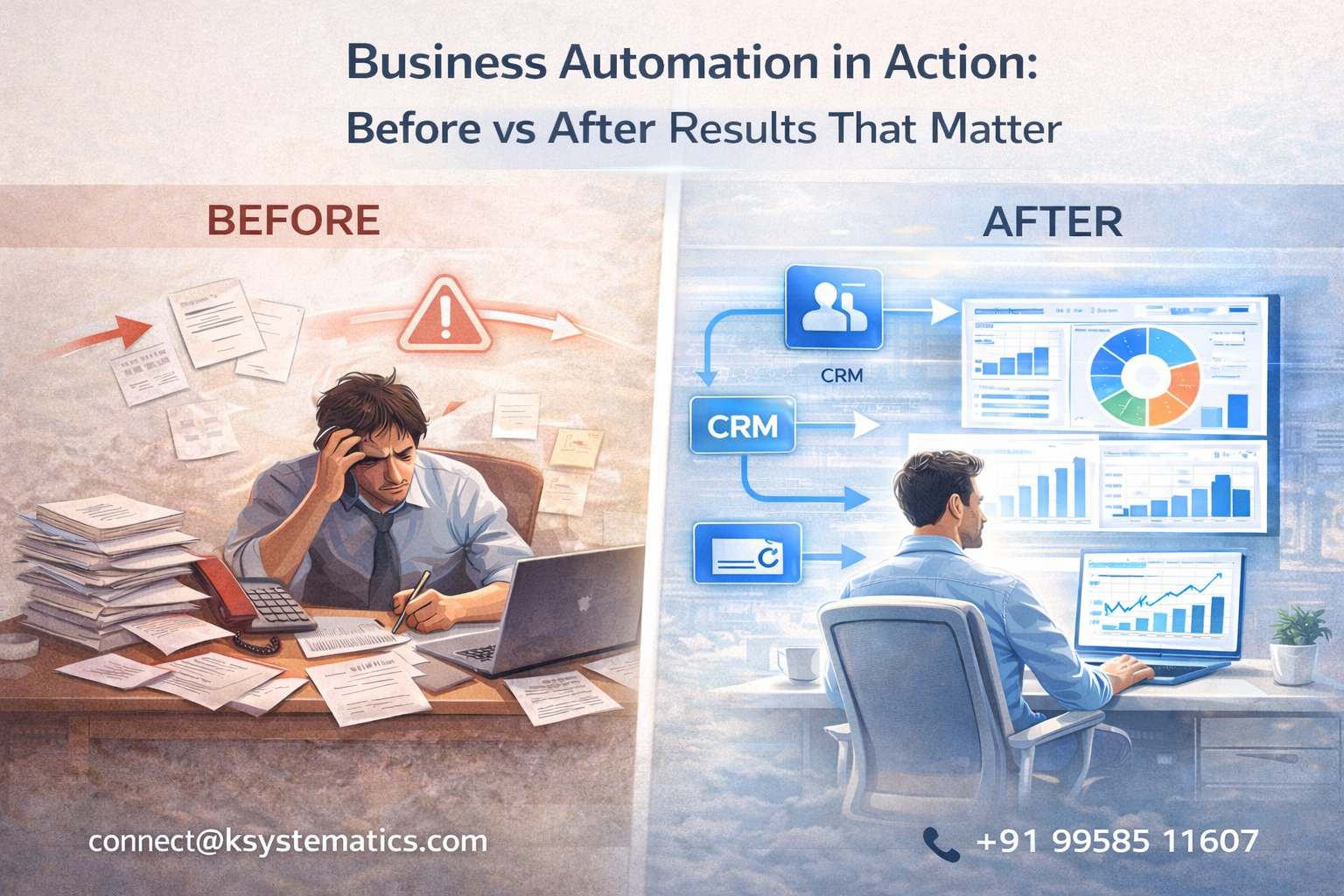
Business Automation in Action: Before vs After Results That Matter
Understanding Business Automation in Today’s Competitive Landscape
In today’s fast-moving digital economy, businesses are under constant pressure to deliver faster services, reduce costs, and make smarter decisions. Companies that still rely on manual processes, disconnected tools, and repetitive tasks often struggle to keep up. This is where business automation becomes a critical growth driver for modern organizations.
Business automation refers to the use of technology to automate repetitive, rule-based, and data-driven processes across departments such as sales, operations, finance, customer support, and management. When implemented correctly, automation doesn’t just save time it transforms how a business operates at every level.
At Ksystematics, business automation is not treated as a one-size-fits-all solution. Instead, automation is designed around real workflows, real teams, and real business goals ensuring measurable results before and after implementation.

Business Automation in Action: Before vs After Results That Matter
Before Automation: How Manual Processes Hold Businesses Back
Before automation, most businesses face a similar set of challenges, regardless of industry or company size. Manual operations may seem manageable in the early stages, but as the business grows, these processes become bottlenecks.
Manual data entry across multiple tools leads to duplication, errors, and wasted effort. Employees spend hours updating spreadsheets, sending follow-up emails, and coordinating approvals instead of focusing on high value work. This lack of automation directly impacts productivity and profitability.
Businesses operating without integrated business automation systems for daily operations also struggle with poor visibility. Decision-makers do not have access to real-time data, making it difficult to track performance, identify issues, or plan strategically. Reports are often delayed, inaccurate, or incomplete.
From a customer perspective, manual workflows result in slower response times, inconsistent service, and missed opportunities. Over time, this damages brand trust and limits scalability.
Operational Chaos vs Structured Workflows
One of the most common problems before automation is operational chaos. Different departments work in silos, using separate tools that do not communicate with each other. Sales teams track leads in one system, finance manages invoices in another, and operations rely on emails or spreadsheets.
Without workflow automation for business process management, tasks fall through the cracks. Deadlines are missed, accountability is unclear, and management spends more time firefighting than planning growth.
Ksystematics often encounters businesses where employees are working hard but outcomes remain inconsistent due to the absence of structured, automated workflows.
After Automation: What Changes When Systems Start Working for You
After implementing business automation, the difference is immediate and measurable. Automated systems replace repetitive tasks, streamline workflows, and create a single source of truth across the organization.
With custom business automation solutions designed for scalability, processes become faster, more accurate, and easier to manage. Data flows automatically between departments, reducing errors and eliminating manual handovers.
Employees no longer waste time on repetitive work. Instead, they focus on strategy, innovation, and customer engagement. This shift leads to higher job satisfaction and better overall performance.
Real-Time Visibility and Smarter Decision-Making
One of the biggest advantages after automation is access to real-time insights. Automated dashboards provide instant visibility into sales performance, operational efficiency, customer behavior, and financial health.
Businesses using real-time automated reporting systems for decision-making can respond quickly to market changes and internal challenges. Leaders no longer rely on outdated reports or guesswork.
Ksystematics builds intelligent dashboards that combine data from CRM, ERP, finance, and operations into a unified view—empowering management with actionable insights.
Before vs After Automation: A Clear Comparison
Before automation, processes are slow, fragmented, and dependent on manual effort. Errors are common, accountability is unclear, and scaling the business becomes difficult.
After automation, workflows are streamlined, systems are connected, and performance is measurable. Tasks are completed faster, accuracy improves, and businesses gain complete operational control.
This before-and-after transformation is not theoretical. It is a practical, results-driven change that Ksystematics delivers through end-to-end business process automation services for growing companies.
How Business Automation Improves Efficiency Across Departments
Automation impacts every department differently, but the overall effect is improved efficiency and collaboration.
Sales teams benefit from automated lead management, follow-ups, and pipeline tracking. Operations teams gain structured workflows and task automation. Finance departments experience faster invoicing, payment tracking, and reporting. Customer support teams respond faster with automated ticketing and communication systems.
By implementing department-wise business automation tailored to operational needs, Ksystematics ensures that automation enhances productivity without disrupting existing workflows.
Scalability: Growing Without Increasing Complexity
One of the biggest limitations of manual processes is scalability. As transaction volumes increase, manual systems break down. Hiring more people to manage inefficiencies only increases costs.
Automation allows businesses to scale without increasing complexity. Automated workflows handle higher volumes effortlessly, ensuring consistent performance even during growth phases.
With scalable automation systems for expanding businesses, Ksystematics enables companies to grow confidently without operational strain.
Cost Reduction Through Smart Automation
Manual processes are expensive, even when they don’t appear so on the surface. Hidden costs include wasted time, rework due to errors, delayed decisions, and missed opportunities.
Automation reduces these costs by eliminating inefficiencies and improving accuracy. Businesses that adopt cost-effective business automation solutions for long-term growth see measurable improvements in operational margins.
Ksystematics focuses on ROI-driven automation, ensuring that every system implemented delivers tangible business value.
Security, Compliance, and Process Control
Manual processes often lack proper security controls and audit trails. Sensitive data stored in spreadsheets or emails increases the risk of breaches and compliance issues.
Automated systems provide role-based access, data security, and complete audit logs. Businesses gain better control over processes while meeting regulatory requirements.
Through secure business automation frameworks built for compliance, Ksystematics ensures data integrity and operational transparency.
Customization Over Generic Automation Tools
Many businesses fail with automation because they rely on generic tools that do not align with their workflows. Off-the-shelf solutions often create more problems than they solve.
Ksystematics takes a different approach by building custom automation systems aligned with real business processes. Every workflow is designed after understanding how the business operates, ensuring smooth adoption and long-term success.
Industry-Specific Automation Use Cases
Business automation is not limited to one industry. Real estate, education, manufacturing, healthcare, travel, and service-based businesses all benefit from tailored automation.
From automated lead handling in real estate to process automation in enterprise operations, Ksystematics delivers industry-specific business automation solutions that drive measurable results.
Employee Productivity and Business Culture Transformation
Automation does not replace people—it empowers them. Employees work more efficiently when systems handle repetitive tasks.
Businesses that adopt automation-driven productivity improvement strategies experience a positive cultural shift. Teams become proactive, data-driven, and innovation-focused.
Ksystematics ensures smooth change management so teams adapt comfortably to automated systems.
Measuring Success After Automation Implementation
Success after automation is measured through faster turnaround times, reduced errors, improved customer satisfaction, and better financial performance.
With automation performance tracking and analytics systems, businesses can continuously optimize processes and improve outcomes.
Ksystematics provides ongoing support and optimization to ensure automation continues to deliver value as the business evolves.
Why Ksystematics Is the Right Partner for Business Automation
Automation success depends not just on technology, but on implementation expertise. Ksystematics combines technical excellence with deep business understanding.
From process mapping to system development and integration, Ksystematics delivers end-to-end business automation services designed for real growth.
The focus is always on solving real problems, not just deploying software.
The Future of Business Automation
As businesses move toward AI-driven decision-making and intelligent systems, automation will become even more critical.
Companies that invest early in future-ready business automation platforms will gain a competitive advantage in efficiency, agility, and innovation.
Ksystematics continues to evolve its automation capabilities to help businesses stay ahead of the curve.
Common Mistakes Businesses Make Before Starting Automation
Many businesses decide to automate but still fail to see results because of poor planning. One common mistake is automating broken or unclear processes. If workflows are not properly defined, automation only speeds up inefficiency instead of fixing it.
Another issue is choosing tools without understanding business requirements. Businesses often invest in multiple automation tools that do not integrate well, leading to more complexity instead of simplicity. Without proper business process mapping before automation implementation, systems fail to deliver expected outcomes.
Employee resistance is another challenge. When automation is introduced without proper training or communication, teams may feel threatened or confused. Successful automation focuses on empowering people, not replacing them.
How Process Mapping Plays a Critical Role in Automation Success
Before automation begins, understanding how work actually flows inside the organization is essential. Process mapping helps identify bottlenecks, redundancies, and manual dependencies.
By documenting each step clearly, businesses can design automation-ready workflows that improve efficiency and accountability. This ensures that automation delivers measurable improvements rather than cosmetic changes.
Ksystematics follows a structured approach where automation is built only after workflows are simplified and optimized for performance.
Automation and Customer Experience: The Hidden Advantage
While most businesses focus on internal efficiency, automation also has a massive impact on customer experience. Faster response times, consistent communication, and accurate information build trust and satisfaction.
With automated customer interaction systems for faster service delivery, businesses can respond to inquiries, process requests, and resolve issues without delays. Customers experience smoother journeys, which directly improves retention and brand perception.
Automation ensures that customers are not dependent on individual employees but on reliable systems that deliver consistent service.
Before Automation: Reactive Management Style
In manual environments, management is often reactive. Problems are discovered after they occur, and decisions are made based on incomplete information. This leads to stress, inefficiency, and poor long-term planning.
Without centralized automated business monitoring systems, leaders lack control and clarity. Daily operations consume management time, leaving little room for strategic thinking.
After Automation: Proactive and Data-Driven Leadership
After automation, leadership shifts from reactive to proactive. Real time dashboards, alerts, and performance metrics enable managers to anticipate issues before they escalate.
With data-driven automation platforms for executive decision-making, leaders focus on growth, optimization, and innovation rather than firefighting. This cultural shift is one of the most powerful outcomes of automation.
Automation and Compliance Management
Compliance requirements are becoming stricter across industries. Manual compliance tracking increases the risk of errors, penalties, and reputational damage.
Automation ensures compliance by enforcing predefined rules, maintaining audit trails, and generating accurate reports. Businesses using automated compliance and reporting systems reduce risk while improving transparency.
This is especially valuable for finance-heavy and regulated industries.
How Automation Improves Collaboration Between Teams
Disconnected tools create communication gaps between departments. Automation bridges these gaps by connecting systems and workflows.
When sales, operations, finance, and support work on the same automated platform, collaboration improves naturally. Tasks move seamlessly from one team to another without confusion.
With cross-department automation for seamless collaboration, businesses eliminate silos and improve overall efficiency.
Automation ROI: What Businesses Should Measure
Measuring automation success goes beyond cost savings. Key metrics include turnaround time reduction, error rate improvement, customer satisfaction, and employee productivity.
By tracking automation ROI through performance analytics and operational KPIs, businesses can continuously refine processes and maximize value.
Automation is not a one-time project it is an ongoing improvement cycle.
The Role of Customization in Long-Term Automation Success
Every business operates differently. Automation that works for one company may fail for another if workflows are not aligned.
Customized automation ensures that systems fit the business instead of forcing the business to adapt to software limitations. With custom-built automation solutions aligned to operational realities, long-term adoption becomes smoother and more effective.
This flexibility allows businesses to evolve without rebuilding systems repeatedly.
Automation as a Competitive Advantage
In competitive markets, speed and accuracy often determine success. Businesses that automate gain a clear edge by responding faster, operating efficiently, and delivering better customer experiences.
Companies leveraging business automation for competitive differentiation outperform those relying on manual processes. Automation becomes a strategic asset rather than just an operational tool.
Preparing Your Business for Automation
Before starting automation, businesses should assess current workflows, identify pain points, and define clear goals. Automation should be aligned with growth plans, not just short-term fixes.
A readiness assessment helps determine where automation will deliver the highest impact. With strategic automation planning for sustainable growth, businesses avoid wasted investments and implementation failures.
Automation Is a Journey, Not a One-Time Change
Automation does not end after implementation. As businesses grow, processes evolve and systems must adapt.
Continuous optimization ensures automation remains effective over time. Businesses that treat automation as an ongoing strategy benefit from long-term efficiency and scalability.
Final Thoughts: Results That Truly Matter
The difference between businesses before and after automation is clear in speed, accuracy, control, and confidence. Automation replaces guesswork with clarity and chaos with structured systems.
Business Automation in Action: Before vs After Results That Matter is about real transformation not buzzwords or trends.
Businesses that invest in intelligent automation today are building a foundation for sustainable growth tomorrow.